
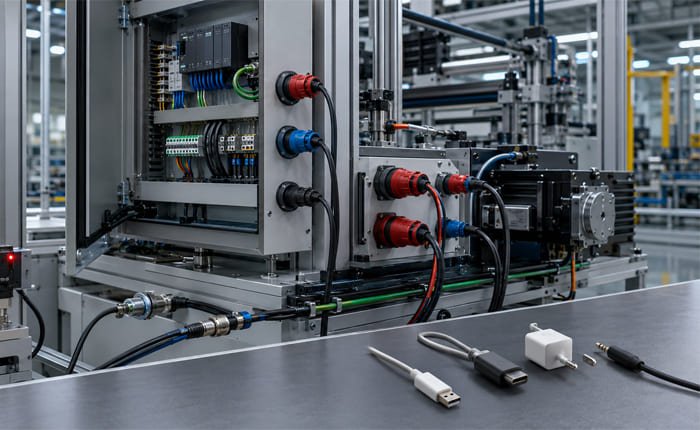
Engineering organisations tend to accumulate connector types the way warehouses accumulate stock-keeping units: one at a time, for good reasons at the time, until the total is far larger than anyone intended and the costs of maintaining the variety are substantial. A medium-sized defence or railway OEM with a product portfolio developed over fifteen years may find dozens of distinct circular connector types across its product range, each requiring its own tooling, its own spare contacts, its own inspection criteria and its own supplier relationship. Connector standardisation — the deliberate process of reducing this variety to a manageable set of families — is one of the highest-return supply chain improvement activities available to such an organisation.
The Costs of Connector Proliferation
The direct costs of connector proliferation are visible in the stores and purchasing functions. Each distinct connector type requires a minimum stockholding of connectors, spare contacts and accessories, which multiplies across dozens of types to produce a stores holding that ties up working capital and requires physical space. Each type also requires a supplier relationship, which means purchase orders, quality system audits, incoming inspection procedures and engineering liaison — overhead that multiplies with type count even if the individual quantities are small.
The indirect costs are less visible but often larger. Assembly technicians trained across dozens of connector types make more errors than those trained on a compact set. Maintenance technicians in the field carry more spare parts to cover the same probability of being able to fix any connector fault. Design engineers specifying for new products default to the connector they used last time, which perpetuates proliferation rather than consolidating it. Quality engineers writing inspection criteria for each new type spend time that could be spent on higher-value work.
The Principle of Necessary Variety
A useful starting principle for standardisation is that the connector variety in a product range should not exceed the variety demanded by the application requirements. Different shell sizes are genuinely required to accommodate different contact counts and wire gauges. Different service classes are required for different environmental exposures. Different coupling styles may be required for different maintenance access conditions. But having three slightly different insert arrangements for the same circuit count because three different engineers specified three different products at three different times is not necessary variety — it is accumulated inertia.
The target of a standardisation exercise is not a single universal connector, which is neither achievable nor desirable, but the minimum set that covers the genuine application variety in the product range. For most defence or railway OEMs, this minimum is smaller than the current count by a significant factor.
How to Conduct a Connector Rationalisation Exercise
Mapping the Current State
A connector rationalisation begins with a complete inventory of connector types across the product range, mapped to their applications, their circuit counts, their environmental requirements and their current suppliers. This mapping exercise frequently reveals that the same circuit function is served by multiple connector types across different products for no technical reason, which identifies the first consolidation opportunities. MG connectors built to VG 95234 and MS-family connectors built to MIL-DTL-5015 together cover the vast majority of circular connector applications in defence and railway products, and a mapping exercise that reveals types outside these two families often identifies candidates for replacement.
Defining the Target Architecture
The target architecture defines the set of connector families, shell sizes and insert arrangements that the organisation will standardise on going forward. This target should be defined jointly by engineering, procurement and maintenance, because each function has constraints that the others must understand. Engineering needs the circuit and environmental coverage to support future designs. Procurement needs supplier commitments and competitive pricing. Maintenance needs a spare parts holding that is practical for field technicians to carry.
Standardisation and Cable Harness Simplification
Connector standardisation has a direct multiplying effect on cable harness assembly economics. A harness manufacturer producing for a range of products that uses a compact set of connector families can amortise tooling investment across a larger volume, maintain consistent process knowledge and reduce the risk of tooling errors when switching between product configurations. The cost per harness falls, the quality consistency improves and the lead time shortens. For OEMs who outsource harness production, presenting a rationalised connector specification to the harness manufacturer is among the most effective ways to reduce harness cost and improve delivery reliability simultaneously.
Managing the Transition
Transitioning a product range to a standardised connector set requires change management as well as engineering. Products in production cannot be changed without formal engineering change control and, for defence products, customer notification and in some cases requalification. Products in service cannot be changed at all without a service bulletin and spares management plan. The transition is therefore a rolling programme over several product generations, not a one-time switch.
The practical approach is to apply the standardised connector set to all new designs from the policy date, to apply it to major redesigns as they occur, and to accept that legacy products will continue with their existing connector types until they reach end of life. This approach stops proliferation immediately while managing the transition to the target architecture over a realistic timescale.
Partnering with the Right Manufacturer
Connector standardisation works best when the OEM partners with a manufacturer who can supply the full range of shell sizes, insert arrangements and accessories within the chosen families from a single source. This eliminates the inter-supplier compatibility risk that arises when different parts of a connector assembly come from different manufacturers. Established circular connector manufacturers in India who manufacture both connectors and harness assemblies, such as Allied Electronics Corporation, provide this single-source coverage with the added benefit of local engineering support for the standardisation exercise itself.
Conclusion
Connector standardisation is a supply chain improvement with consistently positive returns: lower stores cost, simpler maintenance, better harness economics and a stronger supplier relationship. The investment required is primarily engineering time for the mapping and target architecture definition, followed by change management discipline during the transition. For any OEM whose product range has grown through the organic accumulation of connector types, a structured rationalisation exercise is worth scheduling in the next engineering planning cycle.